
The short answer
If the destination country is party to the Hague Apostille Convention, an apostille is normally the only authentication a public document needs. If it is not, consular legalization may apply instead. Confirm with the receiving authority before ordering anything.
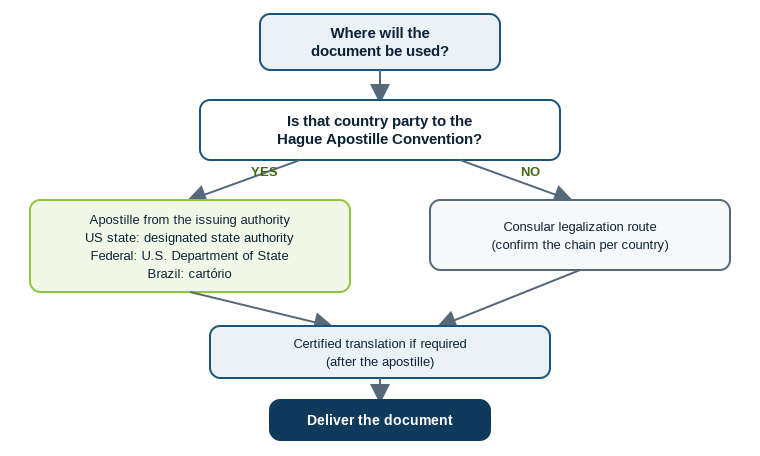
Step 1: Identify the country and the authority
Start with who will receive the document and in which country: a consulate, a court, a civil registry, an immigration office or an employer. The same record can need different treatment for different destinations.
Step 2: Check whether the country is a Hague country
The Hague Conference on Private International Law maintains the official list of Apostille Convention members and their competent authorities. If the destination is a member, plan for an apostille; if not, plan for legalization.
Step 3: Find who issues the apostille
- US state documents (birth, marriage, court records, notarized documents): the state's designated apostille authority, usually the Secretary of State of the issuing state.
- US federal documents, such as an FBI Identity History Summary: the U.S. Department of State.
- Brazilian public documents: authorized notary offices (cartórios).
See the apostille authority of every state on our United States coverage page or in the state-by-state guide.
Step 4: Translate after the apostille
If the destination needs another language, a certified translation follows the apostille, so the translation also covers the apostille text. Translating first, or apostilling a copy that should have been certified first, can mean starting again.
When consular legalization applies
For destinations outside the Convention, documents typically go through additional steps that can include authentication by an authority of the issuing country and by the destination country's consulate. The exact chain varies by country, so we confirm it case by case.
Questions
Does an apostille prove the content is correct?
No. It confirms the authenticity of the signature, the capacity in which the signer acted and the identity of the seal or stamp. It does not confirm the content, and it does not guarantee that the receiving authority will accept the document.
Can one apostille cover documents from several states?
No. Each state's documents are apostilled by that state's designated authority, so a family file with records from several states needs one apostille per document from each authority.
Do copies need to be certified first?
Often, depending on the document and the authority. We confirm the sequence before ordering.